Can Laser Vision Correction Treat Severe Astigmatism?
Astigmatism has a reputation for being the trickiest refractive error to correct, and severe astigmatism takes that reputation a step further. If you’ve been told your prescription is “complicated” or worn glasses your whole life because contacts never quite sat right, you may wonder whether laser vision correction can handle your eyes at all.
In many cases, it can. The key lies in understanding what astigmatism actually does to the eye and matching that understanding to the right procedure.
What Astigmatism Does to Your Vision
Astigmatism occurs when the cornea, or sometimes the eye’s natural lens, curves more steeply in one direction than another. Instead of a smooth, basketball-like curve, the surface looks more like a football, sharper along one axis. That irregular shape causes light to focus at multiple points rather than a single point, which blurs or distorts vision at every distance.
Mild astigmatism often goes unnoticed or gets corrected easily with glasses or toric contact lenses. Severe astigmatism, generally measured beyond 3 to 4 diopters of cylinder, creates more pronounced distortion and can make contact lens fitting especially frustrating, since a lens has to align precisely with an irregular surface to work well.
How Laser Vision Correction Treats Astigmatism
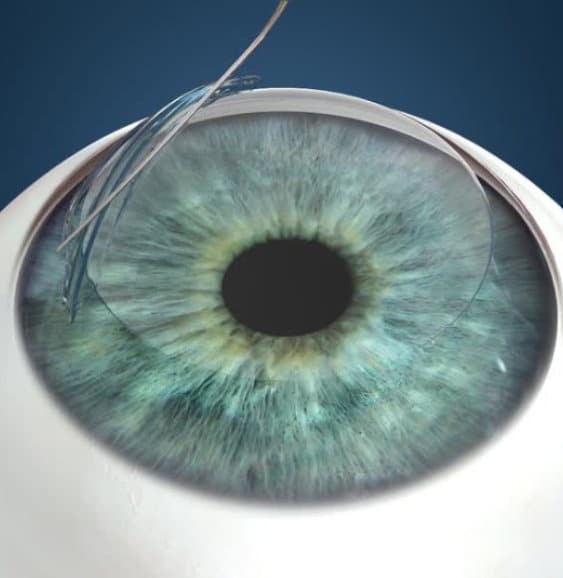
Both LASIK and SMILE can correct astigmatism by reshaping the cornea to smooth out that uneven curve. Rather than removing tissue evenly across the cornea, the laser removes more tissue along the steeper axis and less along the flatter one, gradually evening out the surface until light focuses where it should.
LASIK
LASIK treats astigmatism with high precision using advanced laser mapping that accounts for the exact axis and degree of irregularity in your cornea. Most patients with moderate to severe astigmatism see significant correction, often achieving 20/20 vision or close to it.
SMILE
SMILE corrects astigmatism using a similar principle, removing a precisely shaped disc of tissue without creating a corneal flap. SMILE handles astigmatism up to about 5 diopters in many cases, making it a strong option for higher levels of astigmatism, particularly for patients who also want the faster nerve recovery and reduced dry eye risk that comes with a flap-free approach.
PRK
For patients with thinner corneas or surface irregularities that make LASIK less suitable, PRK offers the same corneal reshaping without a flap, using detailed topography mapping to address irregular astigmatism with precision. Recovery takes longer, but results hold up well long-term.
When Astigmatism Reaches Its Limit
Severe astigmatism, especially when combined with a high prescription for nearsightedness or farsightedness, sometimes exceeds what laser correction can safely treat. Correcting a steep, irregular curve requires removing more corneal tissue than a milder case, and every cornea has a finite amount available. When the combined correction needed would remove too much tissue or leave inadequate corneal thickness, your surgeon will look toward other solutions.
Request a Consultation
We’d love to help you get all the information you need in order to make the best choice for your eyes. Request a consultation today! Our staff is available and happy to answer your every question.
EVO ICL as an Alternative
For patients with very high astigmatism, particularly when paired with significant nearsightedness, the EVO Implantable Collamer Lens often becomes the better fit. Rather than reshaping the cornea, a surgeon implants a thin, flexible toric lens just behind the iris. The toric design corrects astigmatism directly, while leaving the cornea’s structure completely untouched.
EVO ICL treats astigmatism and nearsightedness across a wider combined range than laser procedures can safely reach, which makes it a valuable option for patients who’ve been told their prescription falls outside the laser-treatable zone. The procedure also remains reversible, giving patients added peace of mind if their needs change down the road.
Getting an Accurate Answer
Astigmatism varies enormously from one patient to the next, both in degree and in how it interacts with the rest of your prescription. Two people with the same diopter measurement can require very different treatment approaches depending on their corneal shape and thickness.
A detailed evaluation at Visionmax Eye Centre, including corneal topography and precise measurements, determines whether LASIK, SMILE, PRK, or EVO ICL gives you the clearest and safest path to better vision.
Book your consultation at Visionmax Eye Centre and get a definitive answer for your eyes, not a general rule of thumb.
Take the Next Step
To learn more about whether you’re a candidate for LASIK, please schedule your consultation by either filling out the form on this page or by calling (866) 458-1545. We look forward to helping you!